


Organic Matcha
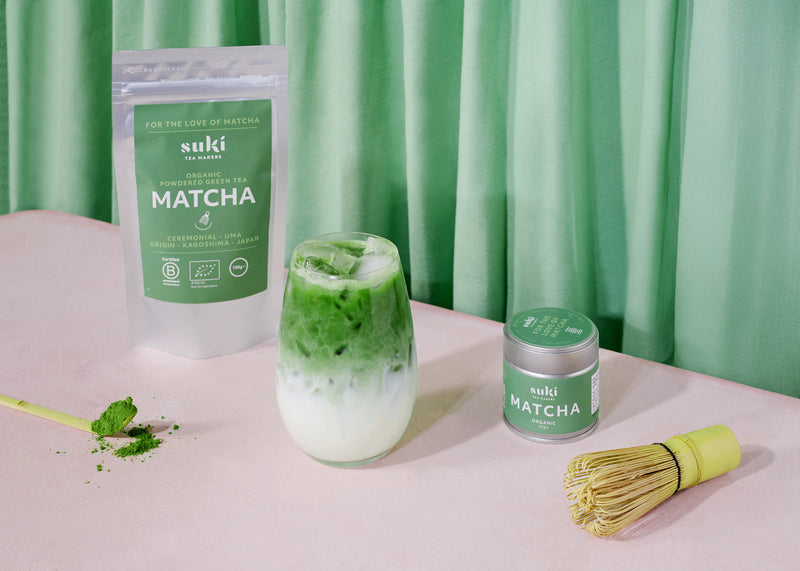
Fine stone ground powder, bright and smooth with an umami finish. Whisk with hot water for a traditional matcha ritual, or build it into an iced or hot latte.
From £22.00
Organic matcha from Kagoshima Japan. Imported by Suki since 2008. A versatile powdered green tea for use in hot drinks, iced lattes, or as part of a traditional matcha ritual.

Shade grown for 21 days before harvest, then stone ground into a powder fine enough to suspend in water. Unlike a loose-leaf green tea, where you remove the infused leaves before drinking, matcha powder dissolves in the water, meaning you drink the whole powdered leaf.
Smooth, sweet, umami. A vibrant emerald green matcha perfect for a hot matcha latte with milk, or to serve over ice.
Matcha is made from young, shade grown leaves. Hojicha is mature tea leaves, roasted until it turns brown and nutty in flavour and low in caffeine. Anyone who enjoys a matcha in the morning, will enjoy a hojicha in the evening.
Fine stone ground powder, bright and smooth with an umami finish. Whisk with hot water for a traditional matcha ritual, or build it into an iced or hot latte.

Green tea roasted over charcoal until it turns amber and nutty. Naturally low in caffeine, which makes it the one to reach for after dark.
You can make matcha with a spoon and a mug. It'll be lumpy and coarse. This is the kit that sorts that out.

The chashaku, or bamboo scoop. A consistent measure every time, so your bowl tastes the same on a Tuesday as it did on Sunday.

The chawan, or matcha bowl. Wide enough to whisk in, heavy enough to stay put. The shape is doing real work, not decoration.

The chasen, or bamboo whisk. Dozens of fine prongs break up every lump and build the foam on top.

For lattes and iced builds where you want speed and froth rather than ceremony.

Bowl, whisk and scoop together. The easiest way to start, and the obvious gift.
The same powder behaves completely differently depending on how you build it. Start traditional, then work outwards.

Water just off the boil, whisked in a W until the surface holds a fine foam. One minute, no equipment beyond a chasen.

Whisk with a splash of cold water first, then pour over a full glass of ice. The colour alone earns its place on the counter.

Matcha holds its own against milk in a way most green teas cannot. Oat works particularly well with the savoury notes.
Powder, water, one minute of whisking. There is a reason the ritual survived five hundred years more or less unchanged, and it is not nostalgia. It is that it works.
Make matcha by sifting the powder into a warmed bowl, adding a little water just off the boil, whisking briskly in a W shape until a fine foam forms, then topping up to drink.
Rinse the bowl with hot water and dry it. A cold bowl pulls the heat straight out of a small volume of water.
Matcha clumps in transit. Sifting is the single step most people skip and the reason most home matcha turns out lumpy.
Let the kettle stand for a minute or two after boiling, or use a variable temperature kettle. Water at a full rolling boil scorches the powder and turns it bitter.
Fast and light in a W shape, from the wrist rather than the shoulder. About a minute is enough to bring up a fine even foam across the surface.
Drink it while the foam holds. Matcha is a suspension, not an infusion, so it will settle if you leave it standing.
Sharp raspberry under milk, with a layer of matcha poured over the top. It looks like a lot more work than it is, and the layers do the work for you as long as you pour slowly.
Muddle the raspberries with the honey in the base of your glass until they break down into a loose syrup.
Pack the glass with ice, right to the top. It keeps the layers apart as well as keeping the drink cold.
Pour milk over the ice until the glass is roughly two thirds full, leaving room for the matcha on top.
Sift the matcha into a bowl, add the water at 85°C and whisk in a W for about a minute until smooth and lightly foamed.
Pour the matcha gently over the back of a spoon so it sits on top rather than mixing straight through. Stir before drinking.
Yes. Matcha contains caffeine, and because the whole leaf is whisked into the water rather than steeped and strained, a bowl of matcha carries more caffeine than the same volume of ordinary green tea. How much depends on how heaped your scoop is.
Excellent quality, delicious matcha that has kept far better than any I've had before, speaking to both its freshness and the superior packaging.Nicolas W., Uma, Kagoshima, 100g
Suki matcha is excellent. Very clean and no sugar or other fillers in it. I start every day with a cup. Highly recommend.Robbie J., Organic Matcha
My absolute favourite: unrivalled quality, versatile and lasts a long time.Sandra P., Organic Matcha
Matcha is Japanese green tea leaf that has been shade grown, dried and stone ground into a fine powder. Unlike other teas it is whisked into water rather than steeped and strained, so you consume the whole leaf rather than an infusion of it.
Yes. Because you drink the whole leaf, a bowl of matcha carries more caffeine than the same volume of steeped green tea. The exact amount depends on how much powder you use, so check the guidance on the pack rather than relying on a single figure.
Green tea is steeped and the leaves are removed. Matcha is ground into powder and whisked into suspension, so nothing is discarded. That changes the taste, the body and how much of the leaf you actually take in.
Not strictly, but it helps. A chasen breaks up clumps and builds foam better than a spoon or a fork. An electric whisk works well for lattes and iced builds where speed matters more than ceremony.
Keep it sealed, cool and out of direct light. Matcha loses colour and brightness faster than leaf tea once it is opened, which is why it is sold in smaller quantities than most of our range.
Yes. Matcha holds its flavour against milk far better than steeped green tea. Whisk it with a small amount of water first so the powder disperses, then add your milk of choice.
All tea contains catechins, chiefly EGCG, and L-theanine, the amino acid behind its sweetness. Because you drink the ground leaf rather than an infusion of it, matcha also gives you the chlorophyll, carotenoids and vitamin K that a steeped cup leaves behind in the leaves. The theanine alongside the caffeine is usually why people describe the lift as steadier than coffee, what we call calm focus.
We started using the term in 2008 to separate real matcha from the latte powders and premixes that were 40% matcha at best, the rest milk powder and sugar. Ceremonial meant the tea stood on its own, whisked with water, nothing added. It still does.
Suki matcha is 100% matcha, organic, from gardens we have visited in the Kagoshima and Kyoto regions.
100% Organic Japanese matcha, smooth, sweet umami.
B Corp Certified.
Interested in wholesale or bulk orders?
Contact us for trade enquiries